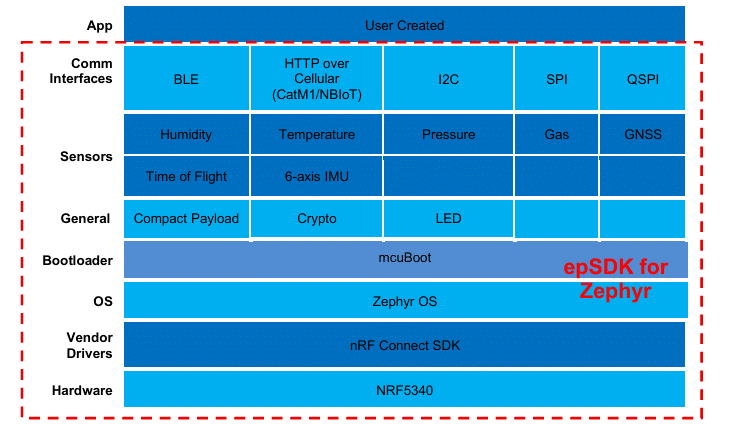
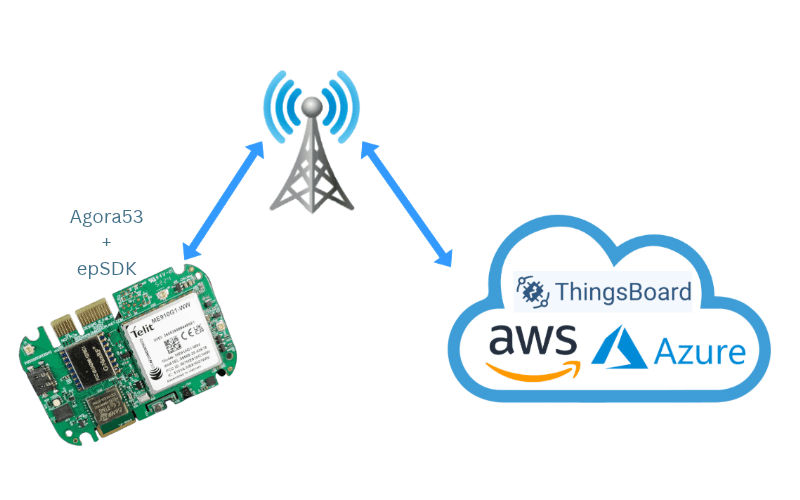
The epSDK Zephyr for Agora53 provides static libraries with example projects to run on a collection of Embedded Planet products.
The epSDK Zephyr is written in C and runs on Zephyr OS within the nRF Connect SDK environment. Users are given example projects that enable them to quickly bring up and program their EP hardware.
The epSDK Zephyr includes drivers, communication interfaces, and other functionality that has been tested and released, providing users a reduced time-to-market experience.
Users can access the public repositories containing the example projects and add the static library file they receive from Embedded Planet to start compiling their own projects.
epSDK Features
- Provides API calls to a wide range of communication interfaces, sensors, and much more
- Includes in-depth documentation and examples for more straightforward integration
- Runs Zephyr OS to enable multitasking and preemption to improve efficiency
- Highly customizable and can be tailored for customer requirements, contact EP to discuss
- Supports for HTTP over cell
- Support for CoAP over NTN is in process, contact EP to discuss
- Support for humidity, temperature, pressure, gas, GNSS, 3-axis accelerometer, 3-axis gyroscope, time-of-flight
- Uses mcuBoot for updating over J-Link or BLE DFU
- Compatible with nRF Connect SDK V3.4.0
- Debug output over UART
- Devices will connect with an EP cloud server, contact EP to discuss compatibility with other endpoints
- Compatible with Thingsboard
- Supports EP Connected Sensor (Agora53)